
In a world where urbanization and infrastructure development are accelerating rapidly, ensuring the safety and resilience of buildings and structures has never been more vital. One of the biggest natural threats to the built environment is earthquake activity and structural engineers must design buildings that not only stand firm during seismic events but also protect lives and minimize damage. This is where PDArch’s structural engineering expertise plays a pivotal role in delivering safe, innovative, and earthquake‑resistant design solutions.
Understanding Earthquake‑Resistant Structural Design
Earthquake‑resistant design is a specialized branch of structural engineering that focuses on creating buildings and infrastructure capable of withstanding seismic shaking without catastrophic failure. A truly safe design recognizes that no building can be totally “earthquake proof”, but with the right planning and structural systems, buildings can be designed to absorb and dissipate energy, avoid collapse, and preserve life safety.
Unlike conventional static design approaches, earthquake design accounts for ground motions, structural ductility, load paths, lateral forces, and dynamic response. These elements work together to ensure a building can flex, redistribute forces, and maintain stability during an earthquake.
Core Principles That Guide PDArch’s Earthquake‑Resistant Designs
At PDArch, earthquake‑resistant design is not an afterthought — it is a foundational element integrated from early planning through execution. Some core principles include:
1. Seismic Hazard and Site Assessment
Before design begins, structural engineers evaluate site‑specific seismic risk. This includes understanding the local seismic hazard, soil conditions, and potential amplification effects, which directly influence the structural system chosen.
2. Clear Load Paths
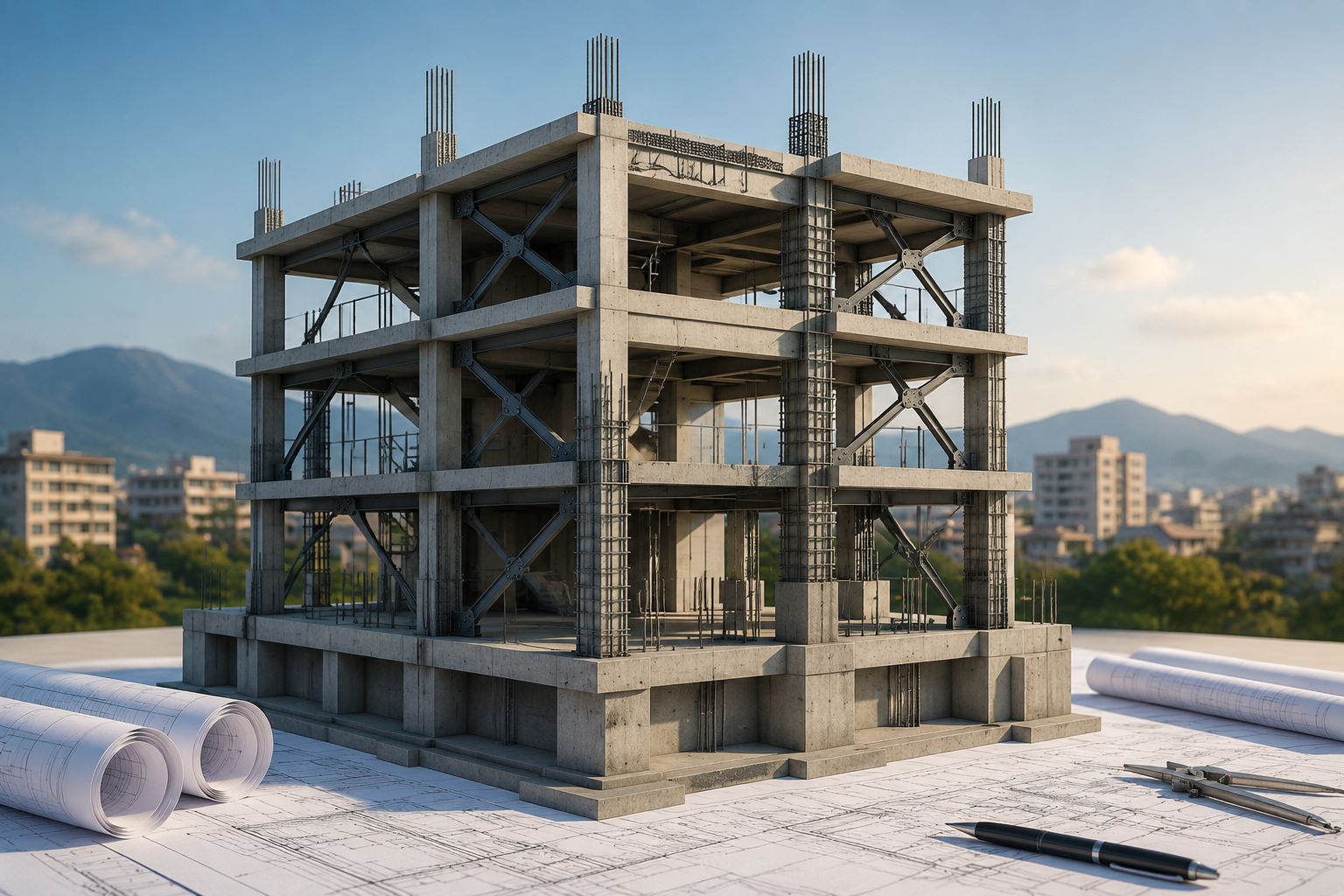
A continuous structural load path ensures that seismic forces travel smoothly from roof diaphragms through lateral systems (such as shear walls and braced frames) down to the foundation. Any breaks in this path can create weak points and increase the risk of failure.
3. Lateral‑Force Resisting Systems
PDArch carefully selects structural systems to resist lateral forces — such as moment‑resisting frames, shear walls, and braced frames — based on building height, occupancy, and seismic design category. These systems work to control lateral displacement and maintain structural integrity.
4. Ductility and Energy Dissipation
Rather than making structures overly rigid (which can be brittle), PDArch incorporates design elements that can deform without losing strength. Ductility allows structures to absorb and dissipate energy during seismic events — reducing the likelihood of brittle failure.
5. Redundancy and Regular Structural Geometry
Structures with redundant elements and simple, symmetrical geometry help distribute forces evenly and avoid stress concentrations that can lead to damage. Irregular shapes and abrupt stiffness changes can cause torsional effects and uneven force distribution, which PDArch carefully avoids.
6. Strong Connections and Detailing
Connections between beams, columns, shear walls, and foundations are meticulously detailed to ensure they remain intact and perform reliably under cyclic seismic loading. Quality detailing greatly enhances a building’s resilience.
Advanced Techniques: Base Isolation and Energy Dissipation
In addition to traditional design principles, PDArch incorporates innovative solutions when project requirements or performance objectives demand higher seismic performance, including:
- Base Isolation: Inserting specially engineered bearings between structures and foundations can substantially reduce the seismic forces transmitted to the superstructure.
- Damping Devices: Tuned mass dampers and viscous dampers help dissipate seismic energy, lowering acceleration and deflection demands.
These advanced techniques are especially useful for critical infrastructure like hospitals, bridges, and tall buildings where reducing damage and ensuring operational continuity are key goals.
The Importance of Codes and Performance Objectives
PDArch designs in accordance with internationally recognized seismic codes and standards such as ASCE 7, Eurocode 8, and region‑specific provisions. These performance‑based provisions help engineers specify not just life safety criteria but also operational and damage limitation objectives depending on the project’s context.
Benefits of Earthquake‑Resistant Design
An earthquake‑resistant structure provides extensive benefits:
- Life Safety: The primary goal is to prevent collapse and protect occupants.
- Reduced Structural Damage: Designed systems help control deformation and prevent catastrophic failure.
- Economic Value: Structures that resist earthquake forces can reduce repair costs and downtime post‑event.
- Community Resilience: Buildings that remain standing contribute to the community’s ability to recover following seismic events.
Understanding and implementing seismic design techniques reduces risk and enhances both human safety and structural performance.
How PDArch Integrates Safety From Concept to Completion?
Earthquake resistance is embedded in every phase of PDArch’s design process:
- Site & Seismic Assessment: Evaluate hazards, soil conditions, and regional seismic codes.
- Conceptual Structural Design: Develop systems with clear load paths and ductile elements.
- Detailed Engineering: Perform seismic analysis, select lateral systems, and detail connections.
- Performance Evaluation: Use modern analysis tools to simulate Earth loads and optimize design.
- Construction Collaboration: Work closely with contractors to ensure design intent is achieved on site.
This comprehensive methodology results in structures that not only meet code requirements but also deliver superior safety, resilience, and performance.
Conclusion
With the reality of seismic hazards in many parts of the world, earthquake‑resistant design is non‑negotiable — it is fundamental to responsible structural engineering. By integrating advanced design principles, performance‑based objectives, and innovative technology, PDArch delivers safe, resilient, and cost‑effective structures that protect both life and investment.
Whether you are planning residential towers, commercial complexes, or critical infrastructure, understanding and implementing structural earthquake resistance paves the way for safer built environments that stand the test of nature.