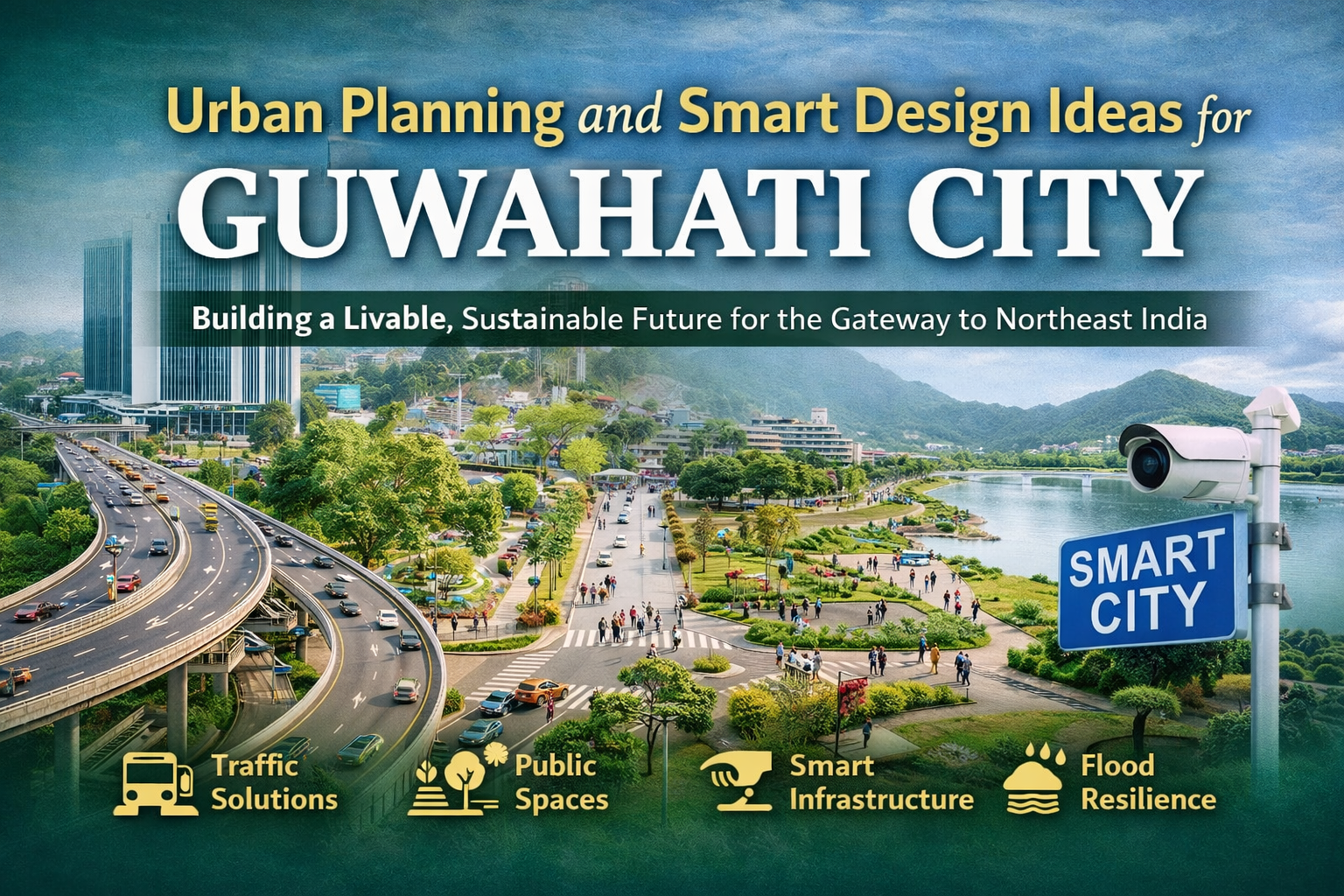
Guwahati, the largest city in Assam and the gateway to Northeast India, is undergoing rapid urbanization. As the city expands in population and economic activity, urban planning and smart design are becoming essential to enhance quality of life, improve infrastructure, and ensure sustainable growth. While Guwahati was selected under the Government of India’s Smart Cities Mission to adopt inclusive growth models and advanced city services, the practical challenges and opportunities remain significant.
In this blog, we explore key urban planning concepts and smart design ideas tailored to Guwahati’s unique geography, infrastructure gaps, and developmental priorities.
Guwahati’s Urban Challenges
Guwahati’s ongoing urbanization has brought intense pressure on infrastructure and services. The city’s topography, characterized by riverine floodplains and rapid suburban expansion, complicates planning efforts. Common issues include traffic congestion, inadequate drainage, informal housing clusters, and environmental degradation.
While smart city initiatives have been launched to address these challenges, experts note a persistent gap between ambitious plans and on-ground execution, often due to governance complexity and infrastructure constraints.
Smart Design Priorities for Guwahati
1. Integrated Urban Mobility and Traffic Management
Traffic bottlenecks and limited mass mobility options remain among Guwahati’s most critical problems. Urban planners emphasize the need for:
-
Enhanced public transit systems, including efficient bus rapid transit and real-time passenger information.
-
Prioritizing pedestrian-friendly streets, cycling infrastructure, and mixed-use corridors over car-centric infrastructure.
-
Deployment of intelligent traffic systems that use sensors and analytics for real-time traffic optimization.
Guwahati has already seen proposals for intelligent city surveillance and traffic management systems aimed at reducing congestion and improving safety.
2. Smart Surveillance, Safety, and Public Services
Public safety can be significantly improved through intelligent infrastructure and data-driven governance:
-
Implementation of city-wide CCTV networks integrated with an Intelligent Command and Control Center (ICCC) improves crime monitoring and emergency response.
-
Smart lighting installations with sensors enhance safety and reduce energy consumption. Recent deployments of high-mast LED lights across the city support this approach.
These systems, when combined with civic data platforms, enhance transparency and responsiveness of city services.
3. Tactical Urbanism and Placemaking
Tactical urbanism focuses on low-cost, quick-implementation interventions that improve public spaces, test design concepts, and build community engagement:
-
The Tactical Urbanism Project at Ganeshguri showcased temporary design prototypes such as pedestrian plazas, pop-up parks, and redesigned street signals that help identify scalable solutions before long-term capital investment.
Such pilot schemes not only improve livability but also involve citizens directly in shaping their city environment.
4. Ecological Urban Design and Flood Resilience
Guwahati’s location on the Brahmaputra floodplain makes it particularly vulnerable to flooding and environmental stressors. Smart urban design ideas include:
-
Restoring and integrating wetlands, beels, and natural drainage networks into city planning to enhance groundwater recharge and reduce flood risk. Urban plans have proposed integrating Deepar Beel and connected water bodies into design frameworks aimed at ecological restoration and recreation.
-
Creating green buffers and urban forest corridors to improve air quality and provide shade in dense areas.
These ecological smart design interventions support climate resilience and sustainable growth.
5. Inclusive Public Spaces and Community Engagement
Smart cities are not just about technology; they must be socially inclusive. Strategies for Guwahati should include:
-
Developing versatile public parks, community gardens, and cultural spaces that encourage social interaction and contribute to wellness.
-
Implementing participatory planning processes where residents can contribute to street design, drainage solutions, and safety initiatives. Citizens’ suggestions in local forums highlight demands for better drainage, more green spaces, and improved civic fundamentals—insights that should inform official planning.
Inclusive design ensures that smart solutions serve diverse populations, including children, women, and the elderly.
Bridging Smart City Vision and Reality
Under India’s broader Smart Cities Mission, smart design emphasizes integrated infrastructure, digital solutions, and governance reforms to elevate service delivery, sustainability, and citizen engagement.
However, evaluations of Guwahati’s smart city progress show mixed results. Rapid growth, environmental constraints, and coordination gaps have slowed the realization of many proposed smart infrastructure projects.
To bridge the gap:
-
Institutional coordination among municipal bodies, state agencies, and community groups must strengthen.
-
Data-driven governance platforms should be paired with urban analytics to improve planning decisions.
-
Long-term investments in mobility, water management, sanitation, and digital services must be sustained.
Conclusion
Urban planning and smart design for Guwahati must be holistic—integrating technology, sustainability, governance, and community participation. By prioritizing mobility, safety, ecological resilience, and public spaces, Guwahati can evolve into a more livable, efficient, and inclusive city.
The path ahead lies not just in implementing smart systems but in aligning them with the lived realities of citizens. Future planning must be grounded in data, empowered by technology, and enriched by the voices of those who call Guwahati home.